

Dubai’s market is setting new records across nearly every sector. Real estate prices are climbing at an annual rate of 5 to 7 percent, fueled by a surge in global investment and fresh government incentives. You might think it’s all about skyscrapers and luxury—but Dubai’s real disruption is happening inside boardrooms, not just on city skylines. The office furniture you choose could make or break your business here, and the fastest-growing companies are betting on flexible workspaces and tech-savvy designs instead of sticking with yesterday’s standards.
Table of Contents
- Understanding Dubai Market Trends In 2025
- Key Regulations And Business Culture In Dubai
- Opportunities For Office Furniture Buyers And Startups
- Tips For Success In The Dubai Corporate Landscape
Quick Summary
| Takeaway | Explanation |
|---|---|
| Dubai Market Shows Strong Economic Growth | Significant growth in multiple sectors indicates robust economic resilience post-pandemic, with investments in food services and luxury markets. |
| Real Estate Growth Driven by Foreign Investment | Annual price growth of 5-7% in real estate reflects attractive government policies, including relaxed visa regulations and tax incentives. |
| Cultural Intelligence Is Key for Success | Understanding local customs and building relationships are critical for navigating Dubai’s business environment and ensuring successful negotiations. |
| Sustainable and Modular Office Furniture Trends | Emphasizing sustainability, modular designs enhance workplace functionality and adaptability for businesses, appealing to startup culture. |
| AI Integration is Essential for Corporate Innovation | Businesses should develop comprehensive strategies that integrate AI while respecting cultural values to enhance operational efficiency. |
Understanding Dubai Market Trends
The Dubai market in represents a dynamic economic ecosystem characterized by significant growth, innovation, and strategic diversification across multiple sectors. Businesses and investors are witnessing a transformative period where technological advancement, strategic government policies, and global economic shifts are reshaping traditional market dynamics.
Economic Resilience and Sectoral Expansion
Dubai’s market demonstrates remarkable resilience and adaptability, with key sectors experiencing substantial growth trajectories. Exploring market opportunities reveals a multifaceted economic landscape that extends beyond traditional revenue streams. According to the Dubai International Chamber, the food services sector is projected to grow from $17.2 billion in 2023 to $22.7 billion by 2028, representing a compound annual growth rate of 5.7%.
The apparel and luxury markets are experiencing significant expansion, with the UAE’s apparel market projected to grow at a compound annual growth rate of 5% between 2024 and 2030. This growth outpaces the global apparel industry’s projected growth of 3.7%, indicating Dubai’s strong consumer market and international appeal. The luxury segment, in particular, demonstrates accelerated growth with a projected CAGR of 3.0% to 2030.
Investment and Real Estate Dynamics
Real estate continues to be a critical component of Dubai’s market strategy. Forbes research indicates a projected steady price growth of 5-7% annually, driven by strategic government initiatives and robust foreign investment. Key factors contributing to this growth include progressive property law reforms, relaxed visa regulations, and attractive tax incentives designed to enhance Dubai’s global investment attractiveness.
The market’s evolution is characterized by a comprehensive approach to attracting international businesses and investors. Government policies are increasingly focused on creating a supportive ecosystem that encourages innovation, technological integration, and sustainable economic development. This strategic positioning enables Dubai to maintain its competitive edge in the global marketplace, offering unique opportunities across technology, finance, tourism, and emerging sectors.
Investors and businesses looking to engage with the Dubai market should focus on understanding these nuanced trends, recognizing the city’s commitment to economic diversification, technological innovation, and creating a globally competitive business environment. The market’s resilience, coupled with forward-thinking policies and a strategic geographical location, positions Dubai as a premier destination for international investment and business expansion.
To give a clearer picture of Dubai’s sector growth trends through, here is a summary table with key statistics mentioned in this section:
| Sector | Projected Value/Change | Compound Annual Growth Rate (CAGR) | Notable Trends |
|---|---|---|---|
| Food Services | $17.2B (2023) to $22.7B (2028) | 5.7% | Driven by international investment |
| Apparel Market | – | 5% (UAE, 2024–2030) | Outpacing global growth (3.7% CAGR) |
| Luxury Segment | – | 3.0% (to 2030) | Strong consumer/international appeal |
| Real Estate | 5-7% annual price growth | – | Fueled by foreign investment, incentives |
Key Regulations and Business Culture in Dubai
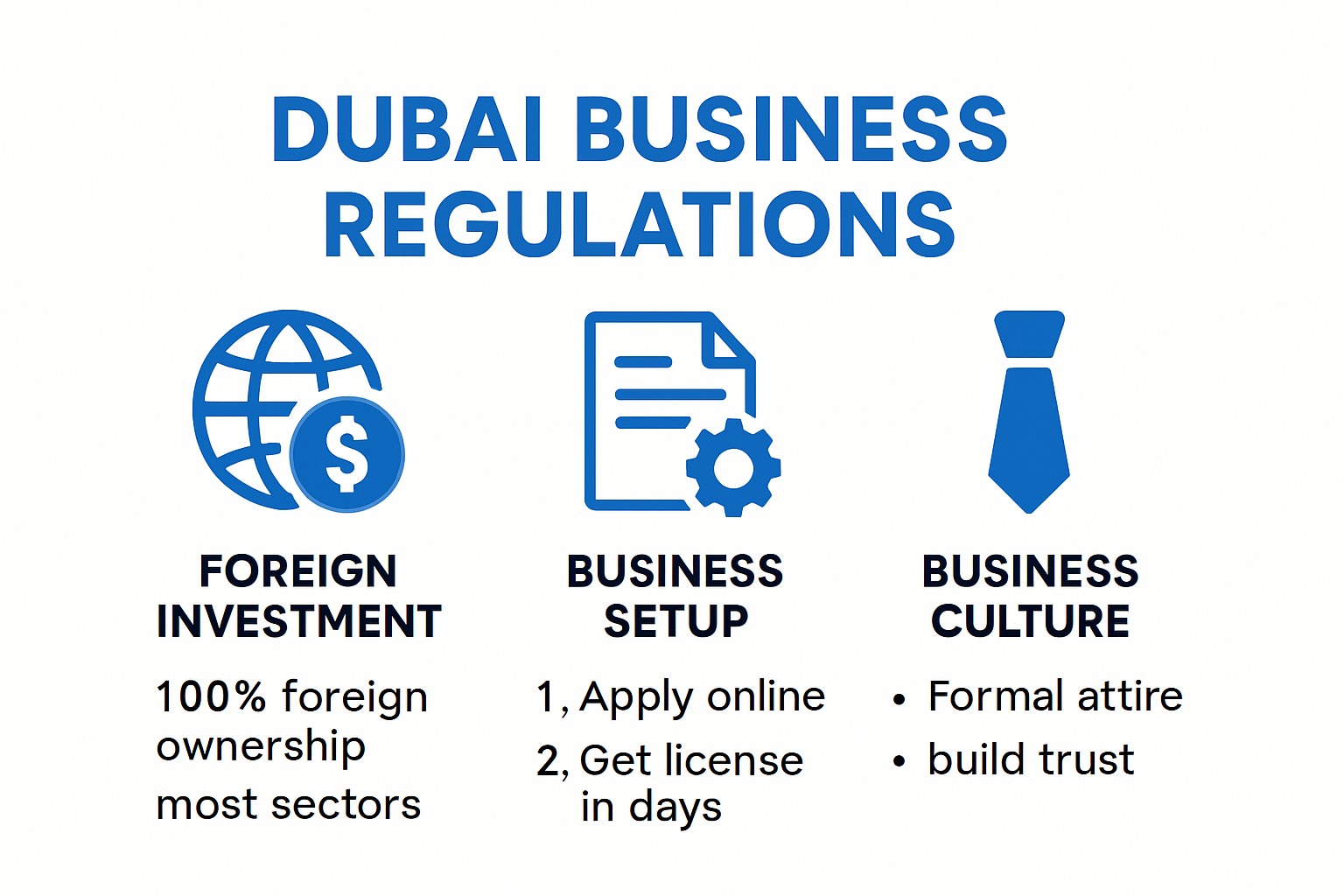
Navigating the Dubai business environment requires a nuanced understanding of complex regulatory frameworks and unique cultural dynamics that shape commercial interactions. The city’s regulatory landscape has evolved significantly, creating an ecosystem that balances international business standards with local cultural expectations.
Legal and Regulatory Framework
Dubai’s regulatory environment continues to demonstrate remarkable agility, with strategic legal reforms designed to attract global businesses and enhance economic competitiveness. Explore business compliance guidelines to understand the intricate regulatory mechanisms. According to the Dubai Government Protocol, the introduction of Law No. (7) represents a significant milestone in contracting activities regulation, establishing a comprehensive framework for contractor classification and creating the ‘Contracting Activities Regulation and Development Committee’ to promote transparency and accountability.
Key regulatory developments include enhanced foreign investment protections, streamlined business setup procedures, and more flexible ownership regulations. The government has implemented digital platforms that simplify regulatory compliance, reducing bureaucratic processes and enabling faster business registration and operational approvals. These initiatives signal Dubai’s commitment to creating a business-friendly environment that attracts international entrepreneurs and corporations.
Business Cultural Nuances
Business culture in Dubai remains deeply rooted in traditional Arab hospitality principles while simultaneously embracing global professional standards. Relationships and personal connections continue to play a crucial role in business negotiations, with an emphasis on respect, trust, and mutual understanding. The British Chamber of Commerce Dubai highlights the importance of understanding local customs, such as the significance of personal introductions, the role of intermediaries, and the value placed on face-to-face meetings.
Professional interactions are characterized by a blend of formality and warmth. Business attire remains conservative, with formal suits for men and modest professional clothing for women. Communication styles prioritize indirect communication and diplomatic language, with an emphasis on maintaining harmony and avoiding direct confrontation. Professionals are expected to demonstrate patience, respect hierarchical structures, and invest time in building genuine relationships before discussing business transactions.
The tax environment has also seen notable changes, such as the reintroduction of a 30% municipality tax on alcohol sales effective January 1, 2025, which impacts businesses in hospitality and retail sectors. Such regulatory adjustments underscore the dynamic nature of Dubai’s business ecosystem and the need for continuous adaptation.
Businesses operating in Dubai must approach the market with cultural intelligence, understanding that success depends not just on technical competence but on genuine cultural engagement. The ability to navigate these complex regulatory and cultural landscapes distinguishes successful international enterprises in this vibrant economic hub.
To help readers navigate Dubai’s key legal reforms and business cultural practices, here is a table summarizing main regulatory and cultural factors:
| Factor | Description | 2025 Update/Impact |
|---|---|---|
| Law No. (7) of 2025 | Regulates contracting activities, contractor classification | Fosters transparency & accountability |
| Business Setup Procedures | Steps to register & operate a company | More streamlined and digitized |
| Foreign Investment Protections | Legal measures favoring foreign investors | Enhanced incentives and flexibility |
| Ownership Regulations | Rules regarding foreign/local business ownership | More flexible for international investors |
| Alcohol Municipality Tax | 30% tax reintroduced on alcohol sales | Effective Jan 1, 2025; affects hospitality/retail sectors |
| Cultural Norms | Trust/personal ties, formal attire, indirect communication | Still essential for business success |
Opportunities for Office Furniture Buyers and Startups
The Dubai office furniture market in presents a transformative landscape for startups and businesses seeking innovative workspace solutions that blend functionality, sustainability, and design excellence. Emerging trends and technological advancements are creating unprecedented opportunities for those willing to reimagine their workplace environments.
Sustainable and Adaptive Furniture Solutions
Discover smart investment strategies for navigating the evolving office furniture market. According to GL Install, sustainable materials in office furniture manufacturing have increased by more than 40% over the past three years worldwide. This trend is particularly pronounced in the UAE, where businesses are increasingly prioritizing environmentally responsible design choices.
Biophilic design has emerged as a key innovation, integrating natural elements directly into office furniture. Desks with built-in planters, room dividers featuring vertical gardens, and seating with integrated greenery are transforming workplace aesthetics and functionality. These designs go beyond mere decoration, offering tangible benefits such as improved air quality, reduced stress, and enhanced creativity. Sustainable materials like reclaimed wood, recycled plastics, and innovative plant-based textiles are becoming the new standard, providing businesses with furniture that tells a compelling sustainability story.
Modular and Flexible Workspace Innovations
The concept of office furniture has dramatically evolved, with modularity becoming a cornerstone of contemporary design. Research from Arnold’s Office Furniture reveals that over 75% of new office furniture products now feature built-in capabilities for rapid spatial reconfiguration. This approach is particularly valuable for startups in Dubai experiencing rapid growth and changing team dynamics.
Modular systems now allow spaces to transform from private work areas to collaborative zones within minutes. Interior designers are leveraging these innovations to create dynamic environments that can evolve alongside business needs. Some manufacturers are even offering furniture-as-a-service models, where businesses can lease pieces with built-in maintenance and eventual recycling guarantees. This circular economy approach provides financial flexibility and demonstrates a commitment to sustainable business practices.
Technology Integration and Future-Ready Designs
For startups and businesses in Dubai, office furniture is no longer just about physical comfort—it’s about creating intelligent, technology-integrated workspaces. The latest furniture designs incorporate smart features like built-in charging stations, integrated digital displays, and ergonomic technologies that adapt to individual user preferences. Circular design principles are driving innovation, with furniture now designed for easy disassembly, repair, and eventual recycling.
The UAE market is witnessing a significant shift towards furniture that supports hybrid work models. Pieces are being designed with versatility in mind, accommodating both in-office and remote work scenarios. This approach reflects the changing nature of work, where flexibility and adaptability are paramount. For customized office furniture buyers, this means access to solutions that can seamlessly transition between different work environments while maintaining aesthetic appeal and functional excellence.
Businesses looking to establish themselves in Dubai’s competitive market must view office furniture as a strategic investment. The right furniture can communicate brand identity, support employee well-being, and create environments that inspire creativity and collaboration. As the market continues to evolve, those who embrace innovative, sustainable, and technologically integrated furniture solutions will be best positioned to thrive in Dubai’s dynamic business ecosystem.
Tips for Success in the Dubai Corporate Landscape
The Dubai corporate landscape in demands strategic navigation, innovative thinking, and a deep understanding of regional dynamics. Businesses seeking success must develop a nuanced approach that balances global best practices with local cultural insights and emerging technological trends.
Strategic Positioning and Economic Diversification
Explore workspace transformation strategies that align with Dubai’s evolving economic ecosystem. According to Reuters, the Dubai International Financial Centre (DIFC) experienced a remarkable 32% surge in company registrations in the first half, adding 1,081 new firms. This growth reflects the city’s commitment to economic diversification and creating a robust business environment.
Successful corporations in Dubai are those that strategically position themselves within emerging sectors. The region is witnessing a significant shift from oil-dependent economies to knowledge-based systems. Businesses that demonstrate adaptability, invest in local talent, and align with national economic diversification goals will find themselves at a competitive advantage. This means developing strategies that go beyond traditional revenue models and embrace innovation, technology, and sustainable practices.
Technological Innovation and AI Integration
Artificial Intelligence represents a critical frontier for corporate success in Dubai. Research from Gulf Cooperation Council studies indicates that GCC nations are adopting a ‘soft regulation’ approach to AI governance, creating an environment that encourages technological innovation while maintaining ethical standards. Companies that can effectively integrate AI technologies while respecting cultural values will be particularly well-positioned.
The approach to technological integration should be holistic. This means not just implementing AI tools, but developing comprehensive strategies that address potential challenges such as data limitations, talent acquisition, and cultural alignment. Successful businesses will invest in continuous learning, create robust digital infrastructure, and develop AI capabilities that enhance rather than replace human expertise.
Cultural Intelligence and Social Development
Beyond technological capabilities, success in the Dubai corporate landscape requires profound cultural intelligence. Advanced research on GCC economic development highlights the importance of understanding local social dynamics, including improvements in education, healthcare, and women’s rights. Businesses that demonstrate a commitment to social progress and local community development will gain significant competitive advantages.
This involves more than surface-level diversity initiatives. Truly successful companies will create inclusive workplace environments that respect local cultural nuances while fostering innovation and global perspectives. This means developing flexible work models, investing in local talent development, and creating workplace cultures that balance traditional values with progressive thinking.
Navigating the Dubai corporate landscape requires a multifaceted approach. Success is not about implementing a single strategy but developing a comprehensive, adaptive framework that embraces technological innovation, respects cultural intelligence, and aligns with the region’s broader economic goals. Companies that can synthesize these elements will not just survive but thrive in one of the world’s most dynamic business environments.
The most successful organizations will be those that view Dubai not just as a market, but as a strategic partner in their global growth journey. This means investing deeply in understanding local dynamics, building genuine relationships, and contributing meaningfully to the region’s continued economic transformation.
Frequently Asked Questions
What are the key trends in Dubai’s market?
Dubai’s market is characterized by strong economic growth across various sectors, particularly in real estate, food services, and luxury markets. Significant annual real estate price growth of 5-7% is driven by foreign investment and government incentives.
How is the office furniture market evolving in Dubai?
The office furniture market in Dubai is shifting towards sustainable and modular designs that enhance functionality and adaptability. Key trends include the integration of smart technology and biophilic design, reflecting a focus on employee well-being and productivity.
Why is cultural intelligence important for businesses in Dubai?
Cultural intelligence is crucial in Dubai’s business environment, where understanding local customs and building relationships can impact negotiations. A blend of traditional values and modern professionalism shapes interactions, emphasizing respect and trust.
What role does technology play in office design trends in Dubai?
Technology is central to office design trends in Dubai, with an emphasis on integrating smart features like charging stations and ergonomic solutions. This reflects the increased need for flexibility to support hybrid work models and improve operational efficiency.
Ready to Transform Your Office for the Dubai Market?
Dubai businesses are facing major shifts. Rapid growth and increasing competition demand more than just any workspace. The article you just read highlights crucial trends like sustainable office design, flexible modular solutions, and the urgent need to integrate technology for success. If you feel overwhelmed by creating an adaptable environment amid these changes or worry your workspace is falling behind, you are not alone. Many businesses now realize that choosing the right office furniture can shape productivity, employee happiness, and even your reputation in the Dubai market.

SAGTCO is here to solve these challenges with you. We offer a wide range of modern, customizable office furniture designed for Dubai’s ambitious workplaces. If you want to explore real solutions that match the emerging trends in efficiency and sustainability, start with our expert consultation service. Connect today to receive personalized space planning advice and access innovative designs tailored for your specific needs. Transform your workspace into a competitive advantage before the next market shift. Now is your chance to lead. Contact us to get started.
Recommended
- Modern Office Design DUBAI: Inspiring Workspace Trends – Office Furniture Dubai | Buy Modern Office Furniture Dubai – SAGTCO
- Office Furniture Regulations: A Compliance Guide – Office Furniture Dubai | Buy Modern Office Furniture Dubai – SAGTCO
- Office Furniture Stores in Dubai: Transform Your Workspace Today
- Budgeting for Office Furniture for Dubai Businesses: A Smart Guide – Office Furniture Dubai | Buy Modern Office Furniture Dubai – SAGTCO
- [The Future of Digital Marketing: What US and Colorado Businesses Need to Know](https://peakdigital.pro/2025/07/27/future-of-digital-marketing-2025-business-owners-colorado)


